
Broomfield Wood Flooring offers screen and recoat hardwood floors service in Broomfield, CO, serving surrounding cities including Lafayette, Northglenn, Louisville, Westminster and Superior. Over more than 20 years we have found it to be one of the most useful and most misunderstood floor services: done at the right time it restores a floor in a day, and done on the wrong floor it peels or seals damage in.
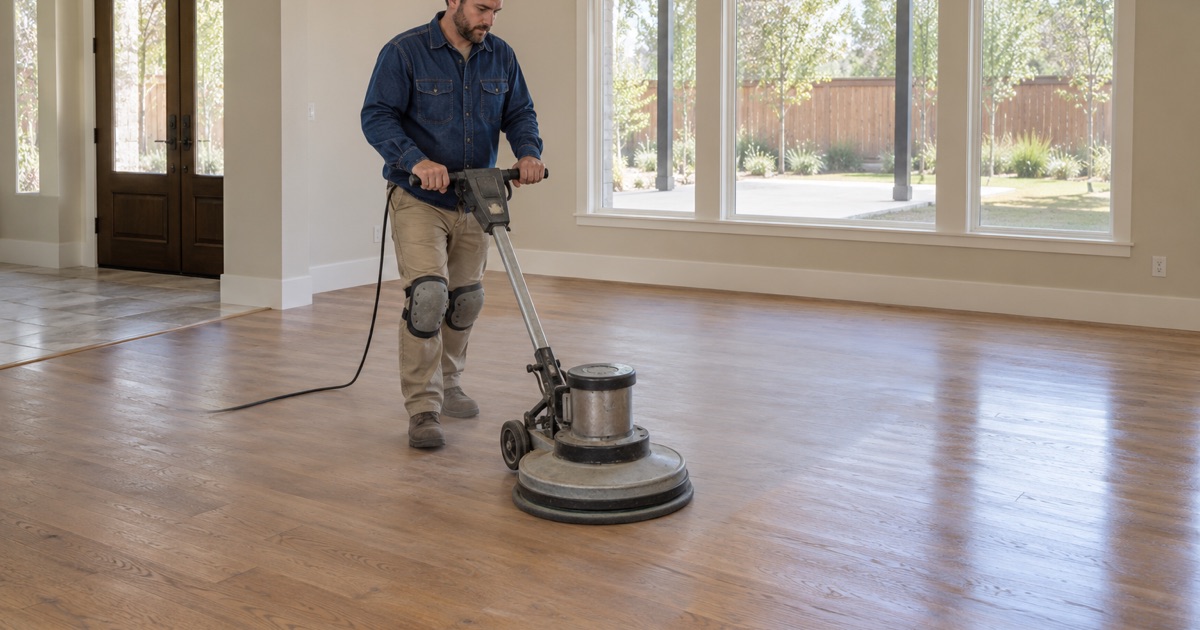
A screen and recoat lightly abrades the existing finish with a fine screen or pad, cleans away the dust, and applies a fresh coat of finish. Nothing is sanded down to bare wood, so there is far less dust and disruption than a full refinish. The result is an even sheen and renewed protection for floors whose wear is still confined to the finish.
When A Screen And Recoat Is The Right Call
Wear That Stays In The Finish
The best candidates are floors that look dull, scuffed or cloudy, especially in traffic lanes, while the wood underneath is still sealed. If water still beads on the worn areas and the scratches are fine lines in the coating rather than grooves in the wood, a recoat will restore the look and add a new protective layer for years of use.
One quick check is to drop a little water on the most worn spot. If it sits on the surface, the finish is still doing its job and a recoat is likely enough; if it soaks in and darkens the wood, the finish has worn through there and the floor needs more.
Maintaining A Floor Before It Needs Sanding
Periodic recoats are the cheapest way to keep a floor from ever reaching the point of a full sanding. Every sanding removes a little of the wood above the tongue, and a floor that is recoated before the finish wears through keeps that wood for later. For busy households with pets, recoating on a regular cycle is often the best long-term value.
Refreshing A Floor Before A Move Or Sale
When a house is going on the market or new owners are about to move in, a recoat gives floors a clean, uniform sheen quickly and with little disruption. It suits floors that are in good condition but look tired, and it can often be completed in a single day with the rooms usable again soon after.
When A Floor Needs More Than A Recoat
Bare Wood, Graying And Deep Scratches
Once the finish has worn through, the exposed wood grays and absorbs dirt, and a recoat over it only seals the discoloration in. Dents, gouges and scratches deep enough to catch a fingernail also sit below the finish, where a light screen cannot reach them. Those floors need a full sanding to bare wood, and we will tell you so rather than sell a recoat that will disappoint.
Changing The Color
A screen and recoat cannot change the stain color, because it never reaches the wood. If you want to move away from an orange oak, a honey tone or a dated dark stain, the floor has to be sanded to bare wood, stained from samples and finished. A recoat can only refresh the color you already have.
Smoke, Soot And Ash After A Wildfire
Floors in homes that stood through a wildfire such as the Marshall Fire can hold soot, ash and smoke residue in the grain, the grooves between boards and any small cracks. Screening and recoating over that residue can seal it under a clear new coat rather than remove it. We inspect those floors closely and often recommend thorough cleaning or a full sanding instead of a recoat.
Adhesion: What Makes Or Breaks A Recoat
Wax, Polish And Cleaner Residue
The most common reason a recoat fails is contamination. Paste wax, acrylic floor polish, oil soaps and some spray cleaners leave films that prevent a new finish from bonding, and the new coat can peel in sheets within weeks. We ask what products have been used on the floor and look for signs of buildup before recommending a recoat.
Testing Adhesion Before The Whole Floor
Before we recoat a floor, we test adhesion on a small, out-of-the-way area. After the test coat cures, we check whether it bonds or scratches away. A few days of patience with a test patch prevents a failed recoat across a whole house, and it tells us whether extra cleaning or a bonding treatment is needed.
Prefinished Factory Finishes
Factory finishes on prefinished floors are extremely hard and slick, which is what makes them durable and also what makes new coats struggle to stick. These floors need a more aggressive abrasion or a chemical bonding system before recoating. We match the preparation to the finish and never simply screen and coat a prefinished floor on assumption.
What To Expect From The Work
Dust, Odor And Staying Home
Screening creates fine dust rather than the heavy sawdust of a full sanding, and we vacuum and tack the floor thoroughly before coating. With a waterborne polyurethane, odor is low and most households stay home, simply keeping off the coated rooms until they are dry.
Choosing The Finish And Sheen
The new coat should be compatible with the existing finish. A waterborne coat over an older oil-modified finish may need a bonding step, and changing the sheen level, from gloss to satin or matte, is often possible with a recoat. We match the product to what is already on the floor so the layers work together.
Care After The Recoat
Felt pads under furniture, mats at the doors and a cleaner approved for the finish keep a recoated floor looking good longest. Avoid waxes and oil soaps, which make the next recoat harder, and keep an eye on indoor humidity through the winter so seasonal gaps do not stress the fresh finish.
- 20+ Years on Wood Floors
- Moisture Readings Before Repairs
- Stain Samples on Your Own Floor