
When a leak reaches your hardwood, Broomfield Wood Flooring handles hardwood floor water damage in Broomfield, CO, serving surrounding cities including Lafayette, Northglenn, Louisville, Westminster and Superior. Across more than 20 years, the rule we hold to has stayed the same: the water is traced, the floor is dried and measured, and the damage is documented before a single board is pulled or replaced.
Water from a burst pipe, a washing machine hose, a supply line under a sink or a roof leak spreads beneath a wood floor in ways that are hard to see from above. A floor that looks ruined on the second day can sometimes be saved, and one that looks fine can still be holding moisture in the subfloor that will cup it a month later.
This page explains what to do in the first days, how to read cupping, crowning and buckling, the process we follow from tracing to final finish, and how we document damage for insurance and handle basements and slabs.
The First Days After Water Reaches A Wood Floor
Stopping The Source
The first job is making sure no more water is coming in. That means shutting off the supply line, the appliance or the main, and confirming the leak has actually stopped rather than slowed. We trace the path the water took, because it often runs along a joist or under a wall plate and surfaces far from where it started.
Some sources are obvious, like a burst pipe or an overflowing tub. Others, like a slow drip from a refrigerator line or a failed wax ring, may have been soaking the subfloor for weeks before anyone noticed. Knowing which one you have changes both the repair and, often, the insurance conversation.
Getting Water Out And Air Moving
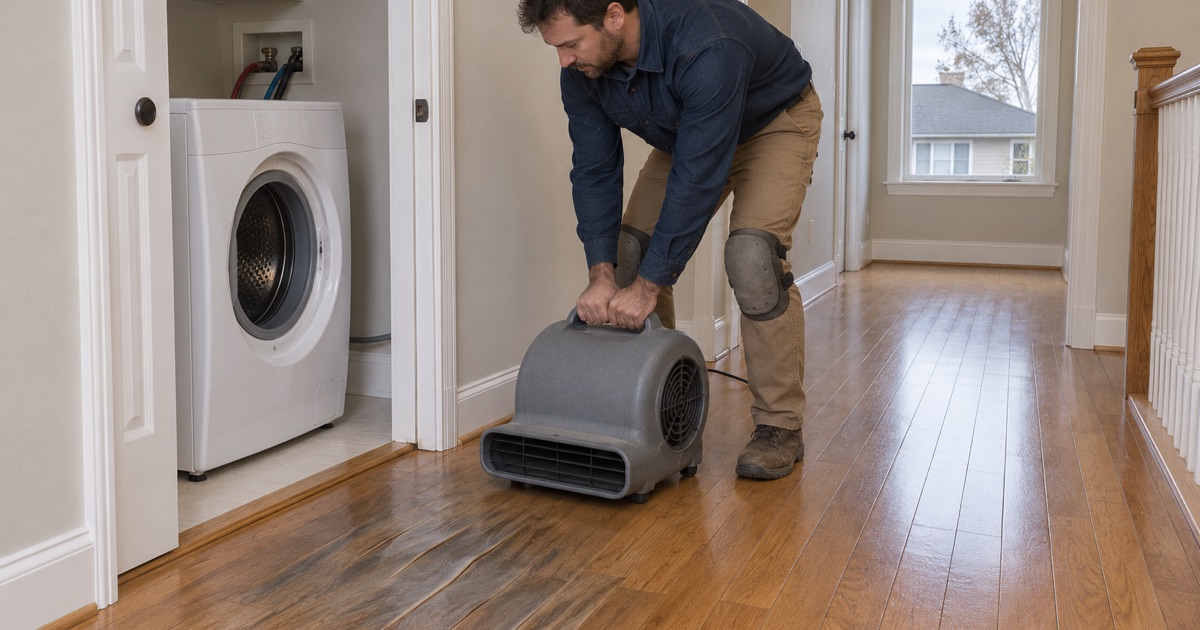
Standing water should be removed immediately, and wet rugs, pads and furniture lifted off the floor. Moisture trapped under a rug or a sofa keeps soaking the wood long after the rest of the room starts to dry, so clearing the surface is one of the most useful things a homeowner can do before help arrives.
What Not To Do In The First Week
Do not sand, nail down or replace boards while the floor is still wet. Sanding a cupped floor too early flattens the edges and leaves the boards crowned once they dry, and new boards installed against wet ones will be the wrong size by the time everything settles. Patience at this stage saves the floor more often than speed.
Reading Water Damage On Hardwood Floors
Cupping
Cupping is the most common sign of water damage: board edges rise above the centers because the underside has taken on more moisture than the face. It tells us moisture is coming from below, whether from the original leak, a wet subfloor or a crawl space, and it is often reversible when the source is dried properly.
We measure how much the boards are cupped and track it as the floor dries. A cup that shrinks steadily is a floor on its way back; one that stays put after the readings have settled usually needs a careful sanding once the wood is fully dry.
Crowning
Crowning is the opposite shape, with the centers higher than the edges. It usually appears when a cupped floor was sanded before it dried, or when moisture reached the top of the boards more than the bottom. Crowned floors often need to be sanded flat once the moisture is stable, which uses up some of the wood above the tongue.
Buckling And Lifted Boards
Buckling happens when the boards swell so much that they push against each other and lift off the subfloor, sometimes by several inches. At that point the fasteners have usually let go, and the affected section needs board replacement rather than drying alone. We mark buckled areas separately so they are not confused with cupped boards that can recover.
Dark Water Stains And Odors
Water that sat on a floor for days can leave dark stains in the wood itself, especially at the seams and around the edges of rugs. A musty odor points to moisture trapped under the floor or in the subfloor, and it is a reason to lift boards and look rather than cover the smell with a new finish.
Our Step-by-Step Hardwood Floor Water Damage Process
Step 1: Tracing And Mapping The Wet Area
We take moisture meter readings across the affected floor and well beyond it, marking where the readings rise and where they return to normal. That map shows how far the water traveled and which rooms need drying, including closets and hallways that look untouched.
Step 2: Drying And Monitoring
The floor and subfloor are dried with air movement and dehumidification, sometimes with panels that draw moisture up through the wood. We record readings on a schedule and compare them with dry parts of the same house, working toward the equilibrium moisture content the floor normally holds.
Step 3: Deciding What Stays And What Goes
Once readings settle, each area is judged on its own. Boards that have flattened and kept their structure can be sanded and refinished. Boards that buckled, stained through or grew mold are marked for replacement, and the subfloor beneath them is checked before new wood goes down.
Step 4: Board Replacement And Refinishing
Replacement boards are woven into the existing floor to avoid a straight seam, then the room or section is sanded through the grit sequence, stained to match if needed, and finished. The goal is a floor that reads as one surface, not a patch surrounded by old wood.
Insurance, Documentation And Below-Grade Floors
Documentation For Your Adjuster
Every affected room gets dated moisture readings, photographs and notes on which boards can be saved, refinished or replaced. That record lets your adjuster see what we see and keeps the decision tied to the floor’s condition, rather than to a room that was torn out before anyone measured it.
We also keep the readings from the drying period, not only the final numbers. A clear record of how the floor dried over time answers most of the questions an adjuster asks about whether the wood could have been saved and why particular boards were replaced.
Sudden Leaks, Slow Leaks And Policy Language
Policies treat water differently depending on how it arrived. A sudden burst pipe, a slow leak behind a dishwasher and water from outside can each fall under different parts of a policy. We describe the source and timeline accurately in our notes, since that description often matters as much as the damage itself.
Basements, Slabs And Floodplain Questions
Water in a basement is harder to dry, because a slab on grade or a structural concrete floor holds moisture longer than a wood subfloor. Engineered floors glued to concrete can lose their bond, and floating floors can trap water underneath. Broomfield maps floodplains along City Park Channel and South Tributary, and whether a particular address falls inside one is a question for the city’s maps rather than for us.
Preventing The Next Leak
After a water loss, we point out what we saw: a brittle supply line, a washing machine without a drain pan, a water heater near the end of its life. Braided supply lines, leak sensors and a humidity plan for the rest of the house all reduce the chance that the new floor meets the same fate.
- 20+ Years on Wood Floors
- Moisture Readings Before Repairs
- Stain Samples on Your Own Floor