Broomfield Wood Flooring handles wood-flooring in Greenwood Village for owners who have lived with their floors a long time and plan to keep living with them. With more than 20 years behind us, we sand, refinish, repair and install wood floors in homes where the boards underfoot have outlasted several kitchens, a few paint colors and more than a few family dinners.
Most of the calls we get from long-held homes start with one question, whether the floor can be saved, and often it can. A site-finished floor that has been down for decades usually carries enough wood above the tongue for another sanding, and we measure that before we quote anything. Where it does not, we say so plainly and walk through board replacement or a new floor instead.
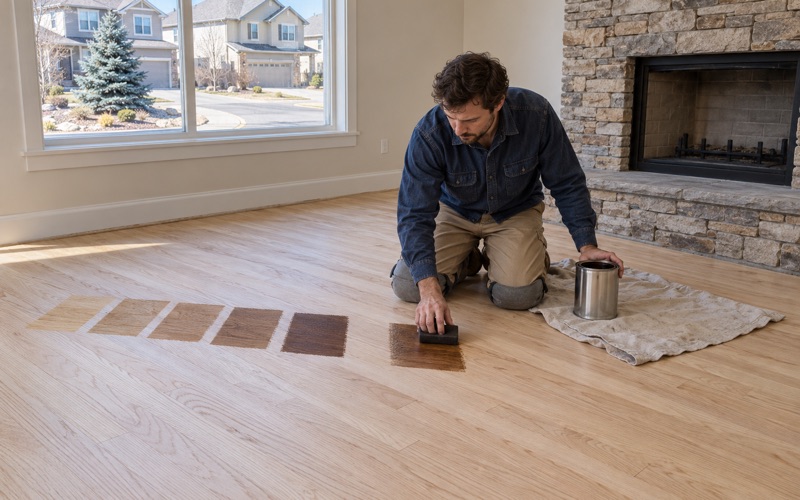
The other half of the work is planning for the years ahead. An owner who expects to stay often wants fewer changes in floor height between rooms, one continuous floor through the main living space, and a finish that is easy to maintain with a screen and recoat. We plan those projects room by room, with stain samples laid on your own floor before any color is chosen.
Wood Floors for Greenwood Village’s Long-Time Owners
Greenwood Village is a home rule municipality in Arapahoe County, and a large share of the people who own homes here are older and long settled. Census figures from the ACS 2024 five-year estimates show a city where many owners bought decades ago and stayed, which shapes nearly every floor conversation we have here.
Owners Who Bought Decades Ago
According to the ACS figures, 36.6 percent of Greenwood Village’s owner householders are 65 or older, and 60.8 percent are 55 or older. Owners at that stage have often lived through a round or two of floor decisions already, and they tend to know what they liked and what wore poorly. We listen to that history before we suggest anything.
Tenure tells the same story. Of 4,239 owner households, 511 moved in during the 1990s and 513 moved in during 1989 or earlier, so 24.2 percent have owned their homes since before 2000. A floor installed or last sanded when those owners arrived may now be carrying decades of traffic lanes, sun fade and small repairs.
What Long Tenure Does to a Wood Floor
A floor that has been walked on by one family for decades wears in patterns. We see gray traffic lanes from the kitchen to the back door, water stains near sinks and pet bowls, and sun fade that leaves a lighter square where a rug sat for years. Red oak finished in a warm tone may have drifted toward the orange oak look many owners now want gone.
Long tenure also means seasonal gaps have opened and closed many times. We read winter gaps against the furnace season that produced them and take moisture meter readings before anyone fills a seam, because a gap packed in January can close by summer and push the filler back out or force the boards to crown.
Looking for wood-flooring closer to Lafayette? See Wood-Flooring in Lafayette.
Refinishing Floors That Have Been Down for Decades
The housing stock here spans several building eras. The 2000s were the largest building decade in Greenwood Village, with 27.6 percent of housing units built from 2000 through 2009, and a site-finished floor from those years may be ready for its first full sanding. Older floors may have been sanded more than once, which is why the first step is always a measurement.
Checking the Wood Above the Tongue
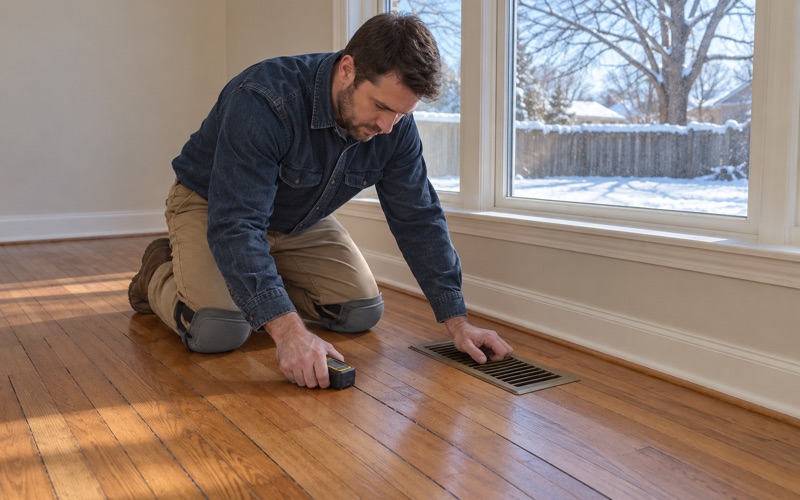
Before we sand a floor that has been refinished once or twice already, we pull a floor vent or a threshold and look at the edge of the board. Solid hardwood can be sanded several times, but only while there is enough wood left above the tongue and groove. Where that layer is thin, a full drum sander pass is off the table.
Engineered floors need the same check with a different measurement. An engineered wear layer may allow a light sanding, or it may allow only a screen and recoat, and veneer cracking or checking in the top layer tells us how much life is left. We report what we find before quoting, so the choice between refinishing and replacing is yours.
Sanding, Staining and Finishing a Worn Floor
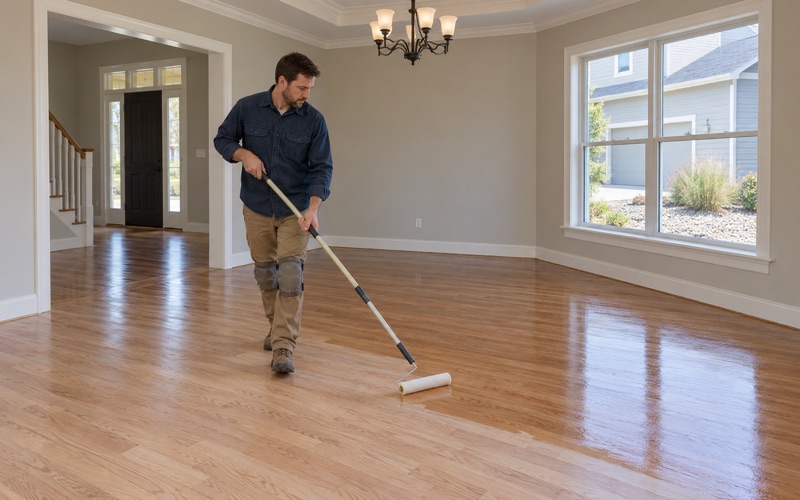
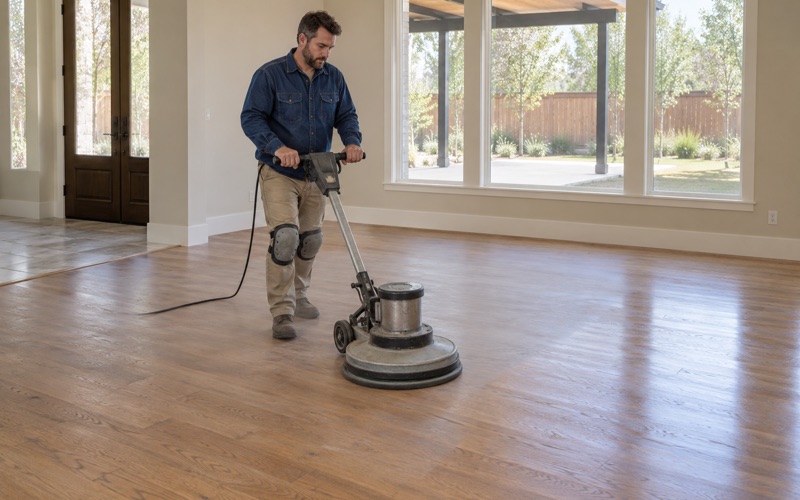
On a floor that can take it, we work through a grit sequence with the drum sander and follow with an orbital sander to take out drum marks, using dustless sanding so an occupied house stays livable. For owners replacing an orange oak tone, water popping opens the grain before stain, and stain samples go down on your own boards in your own light.
Finish choice matters more for a floor you expect to keep for many more years. Waterborne polyurethane stays clearer and dries faster; oil-modified polyurethane ambers over time; hardwax oil can be spot-repaired without sanding the whole room. We talk through sheen level too, since a lower sheen hides the fine scratches that daily walking leaves behind.
Build Year, Painted Trim and Pre-1980 Homes
28.3 percent of Greenwood Village’s housing units were built before 1980, most of them during the 1970s. For any home built before 1978, we confirm the build year and check painted baseboards, trim and stair parts before sanding, because the EPA RRP Rule governs work that disturbs paint in homes of that age. That check happens before the quote, not on sanding day.
In a house from that era, we also look for earlier patches, mismatched boards and board gapping where a wall or cabinet may once have stood, since those spots decide how a refinished floor will read. Sanding makes an old patch more visible, not less, so we plan any weaving in first.
Smoother Transitions in Detached Houses and Condos
Owners who plan to stay put often ask us to take out the small changes in floor height that a house collects over the years: a tile entry, carpet in the bedrooms, a laminate kitchen and a hallway of wood, each meeting the next at its own reducer. Continuous wood through the main rooms is usually the goal.
Replacing Carpet and Mixed Floors with Continuous Wood
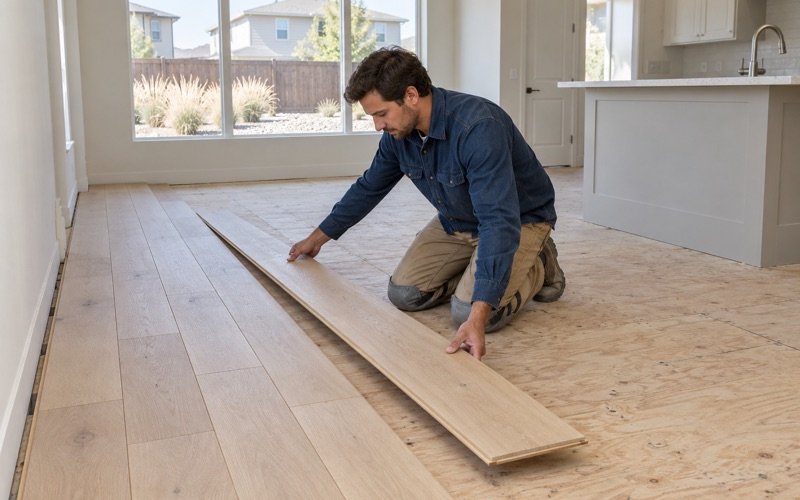
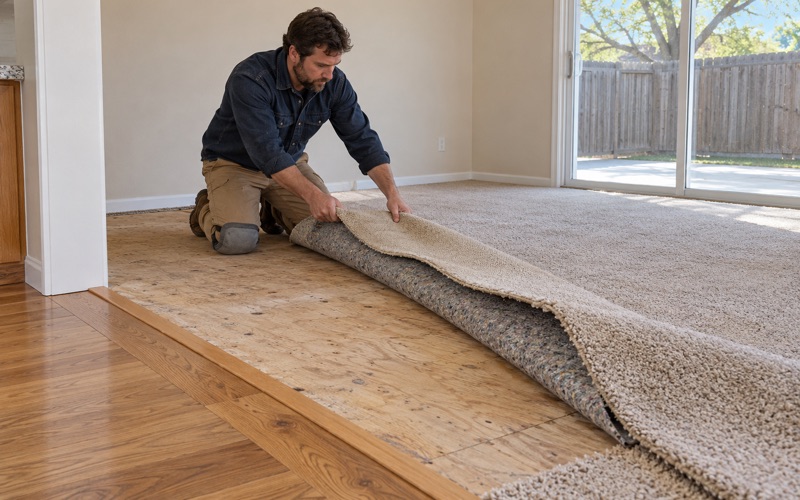
Pulling carpet means pulling the carpet pad and tack strip too, then checking the subfloor for squeaks, hollow spots and old fastener damage before new boards go down. Where a room steps from wood to carpet today, we plan the new floor so the heights line up and the run reads as one surface instead of a patchwork.
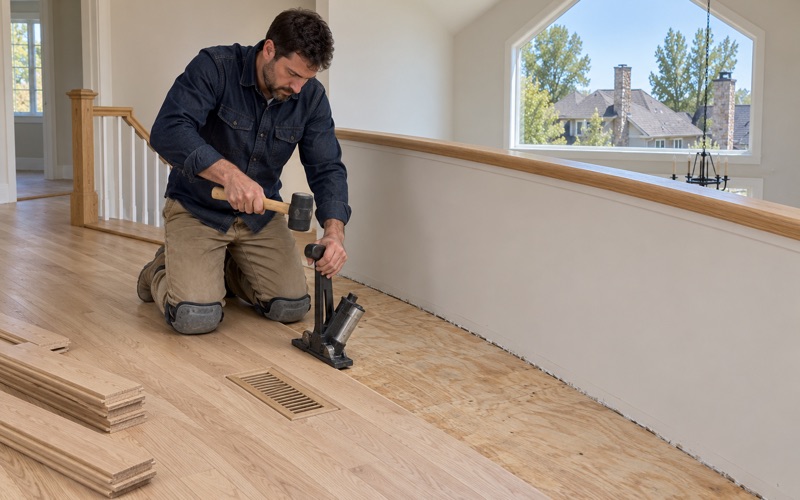
Solid hardwood nailed with flooring cleats or flooring staples suits a wood subfloor over joists. Before new wood goes down, we take moisture readings and let the boards acclimate, because indoor air in a heated Front Range winter runs far drier than the air the boards arrived in, and a floor laid too wet opens up by February.
Thresholds, Reducers and Stair Landings
Some transitions cannot disappear, such as where wood meets tile at a bathroom or entry. There we choose a reducer or a flush threshold that matches the new floor, and we set quarter round and the expansion gap so the edge stays tidy. The aim is fewer, lower and better-matched transitions rather than a promise of none.
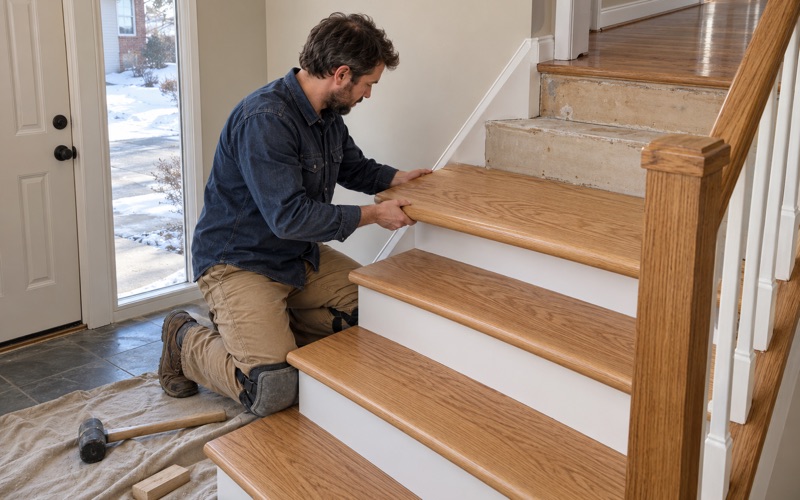
Stairs get quoted tread by tread. When a new floor raises a landing, we check the riser height so the top or bottom step does not end up taller or shorter than the rest, and we match stair nosing and stair treads to the new floor so the staircase reads as part of it.
Detached Houses and Condos Start Differently
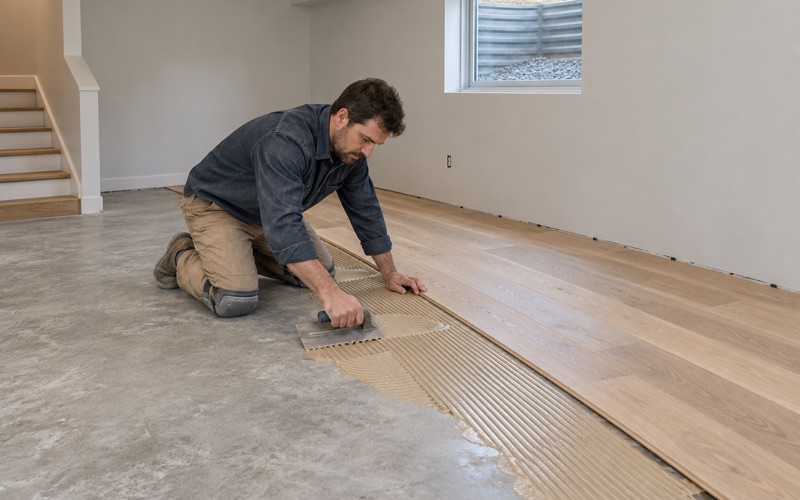
Greenwood Village’s owners live mostly in houses: 3,304 owner households are in one-unit detached homes and 562 are in one-unit attached homes. In a detached house we usually control everything from the subfloor up. Below grade, we check whether a basement floor is slab on grade, structural wood or structural concrete, and use engineered wood where solid wood does not belong.
Condos and attached homes can add a second set of rules. Any interior flooring requirement comes from your own HOA declaration or rules, not from us, so we read those documents before work starts. Glue-down engineered or a floating floor over an underlayment is often the fit when the rules or the concrete below point that way.
Planning a Wood Floor Project in Greenwood Village
Choosing Oak, Hickory or Maple for the Long Run
For a floor meant to last as long as you stay, species and hardness matter. White oak and red oak sand and refinish well for decades; hickory and maple rate higher on the Janka hardness scale but take stain differently. Wide plank boards show seasonal movement more than narrow strips, which is worth knowing before you settle on a sample.
Prefinished boards shorten the time a room is out of use, which suits owners who would rather not move out. Site-finished floors let us sand everything flat and finish it as one surface, which matters when a new floor meets an existing one. Herringbone and parquet suit a single room, like a study, where a pattern can stand alone.
Water Damage, Squeaks and Board Replacement
An older floor often carries a problem or two that should be fixed before it is sanded. Squeaks and popping boards get traced to the joist or fastener behind them rather than masked, and cracking or cupping near a kitchen or laundry gets checked for a slow leak from a supply line or washer.
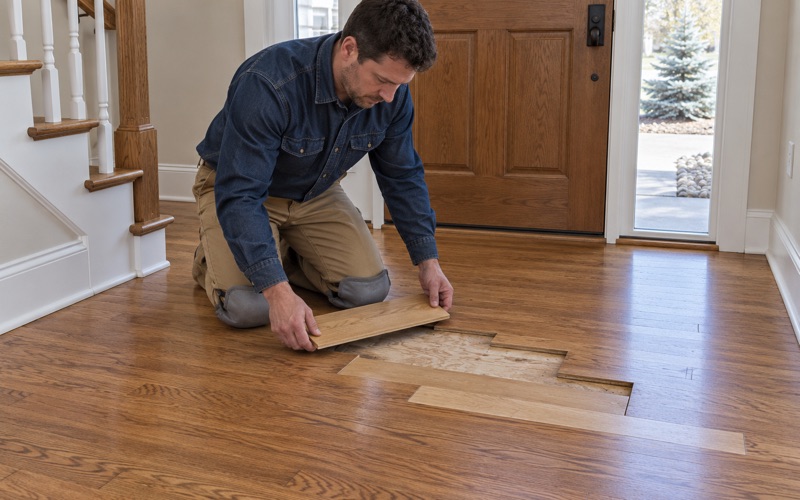
Where water has already done damage, from a burst pipe, a washer or a roof, we trace the source, dry the floor and measure it before any board replacement, and we document each room for the adjuster. Pet urine stains and deep water stains usually need new boards woven in, which we match in species, width and finish.
Codes, Scheduling and Living in the House
The City of Greenwood Village lists the 2018 International Residential Code among its adopted codes, customized to local needs. We plan floor work with that in mind and follow the NWFA Installation Guidelines on moisture, expansion gap and fastening. Whether a given project needs anything from the city is a question for its building department.
Owners who have lived in a house this long often want to keep living in it during the work. We sequence rooms so a bedroom and bathroom stay usable, schedule the finish coats around your routine, and tell you how long to stay off each coat before furniture comes back. Rugs come back last, once the finish has cured enough to take them.
- 20+ Years on Wood Floors
- Moisture Readings Before Repairs
- Stain Samples on Your Own Floor