Broomfield Wood Flooring brings more than 20 years of work to wood-flooring in Federal Heights, where the first question is often about the home itself rather than the species of board. Many owners here live in manufactured homes, and floor work inside one is planned differently. We start by looking at what is underfoot and who manages the lot.
That approach covers every kind of job we take on here: carpet pulled up and replaced with engineered wood, a tired prefinished floor given a screen and recoat, a water stain traced back to a leaking supply line, or popping boards followed to their cause. Each one begins with a moisture meter reading and a conversation about how the room is used.
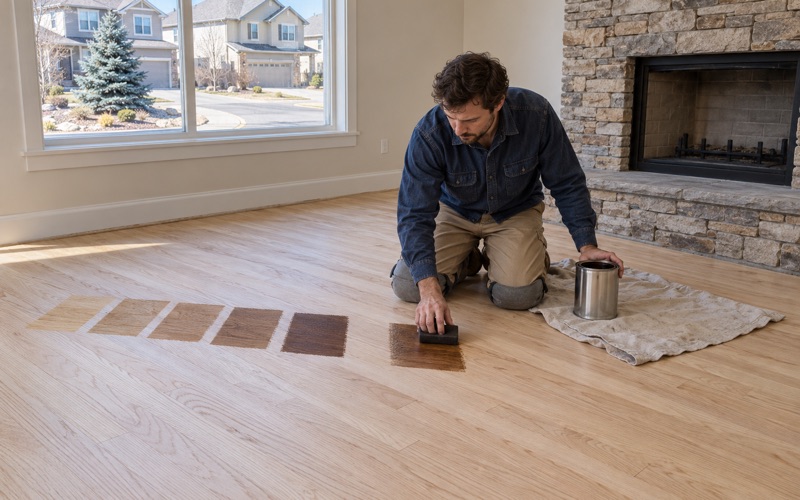
Owners of site-built houses get the same care, from stair treads quoted one at a time to stain samples laid in their own light. This page, though, focuses on what differs inside a manufactured home and what is worth confirming with the park office before a crew shows up with tools.
Manufactured Homes and the Code That Governs Their Parks
Nearly Half of the Housing in Federal Heights
The census numbers make the point plainly. Of the 5,452 housing units in Federal Heights, 2,554 are mobile homes, which is 46.8 percent of the city’s housing stock. Only 1,050 units are one-unit detached houses, so the manufactured home is not a side note here. That shapes how we plan floor work in the city.
Ownership tells the same story. Of 3,117 owner households, 2,037 live in a mobile home, or 65.4 percent. For most people who own their home in Federal Heights, a new floor means work inside a manufactured home. That is the situation the rest of this page is built around, from product choice to the questions worth asking first.
How the City Licenses Parks and Managers
Federal Heights regulates its mobile home parks through its code of ordinances, in the sections covering the R-4 district. The code is direct about operators: no person may run a mobile home park in the city without a license in effect at all times. The owner or operator must also arrange for the park’s management and supervision.
Managers are covered too. Under Section 70-295, a park manager needs a license of their own after 30 days on the job. For a homeowner, the practical upshot is that every park in Federal Heights has someone charged with managing it, and that person is a sensible first call before any contractor arrives.
Set-Up Permits, Skirting and the 20-Year Rule
The code also reaches the homes themselves. Set-up permits are required for a manufactured home under Section 10-42, and a home must have been manufactured no more than 20 years before its initial placement. Homes that do not meet the definition of a manufactured home may not be moved into the R-4 district at all.
Skirting has a standard as well: stucco or a material similar in appearance, or vinyl skirting in good repair. None of this is a floor rule, and we do not treat a set-up permit as covering interior work. Whether a particular floor job needs its own permit is a question we put to the city before we start.
Looking for wood-flooring closer to Dacono? See Dacono Wood-Flooring.
Floor Work Inside a Manufactured Home
Engineered Wood and Floating Floors
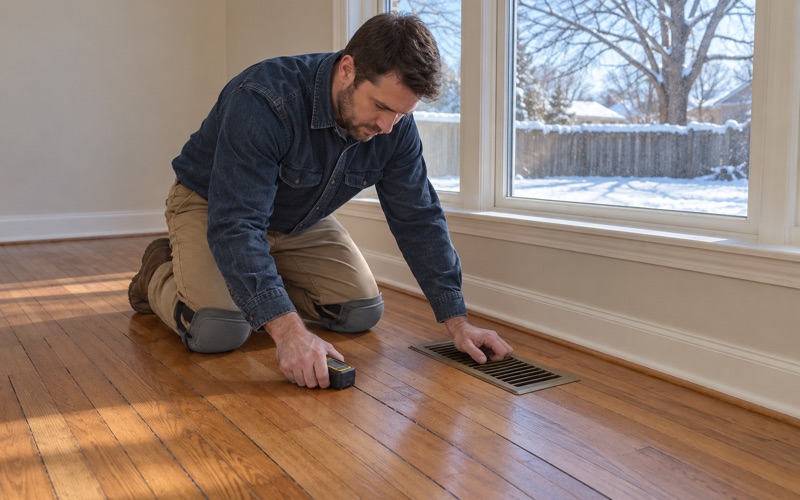
Inside a manufactured home, we do not assume what sits under the carpet or the existing floor. We open a corner, look, and take moisture meter readings before recommending anything. What we find decides the product, not a brochure, and it is why we never quote a floor in this city from a photograph alone.
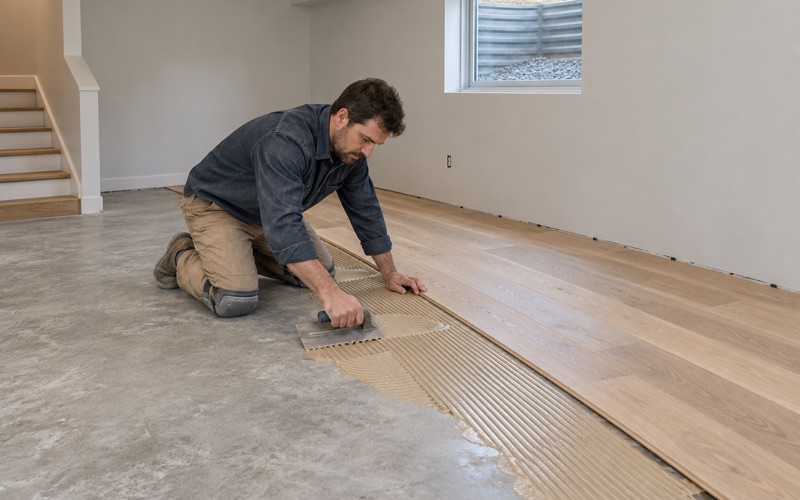
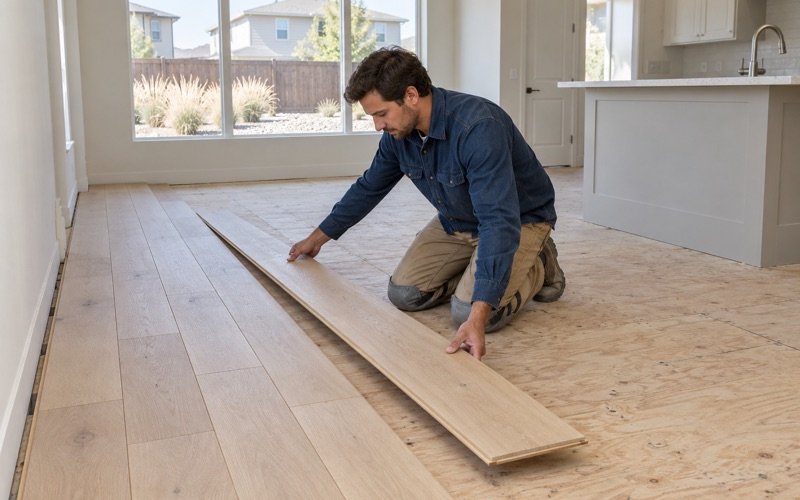
Engineered wood is an option we often discuss in these homes, either glued down or installed as a floating floor over a pad. Its wear layer gives the look of solid hardwood in a thinner board, and a floating install leaves an expansion gap at the walls that quarter round or base trim covers.
Pulling Carpet and Tack Strip
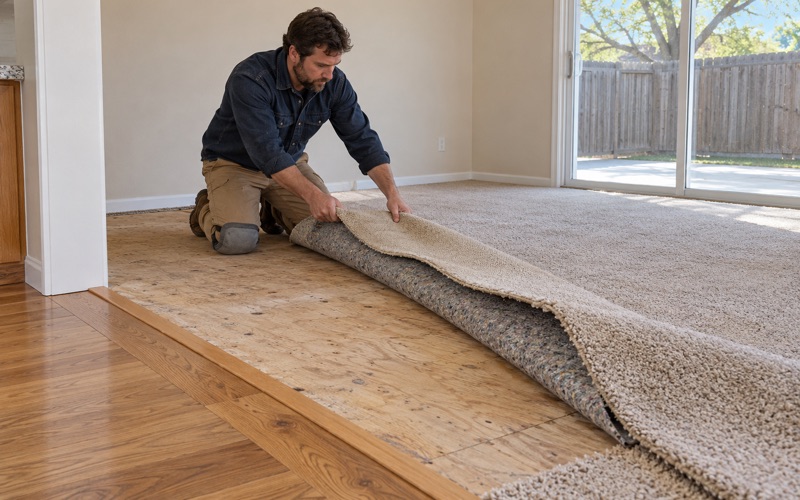
When an owner wants carpet gone, removal is its own step. We pull the carpet, the carpet pad and every tack strip, then check the surface for staples, glue and soft spots before deciding what goes down. Hollow spots and squeaks found at this stage are far cheaper to deal with than after new boards cover them.
Transitions deserve attention in any compact floor plan, where kitchen, hall and living room can meet within a few steps. We plan each reducer so a new wood floor meets vinyl or tile cleanly, and so doors still swing freely over the added height. Where an entry step meets the new floor, we check its rise as well.
Refinishing Instead of Replacing
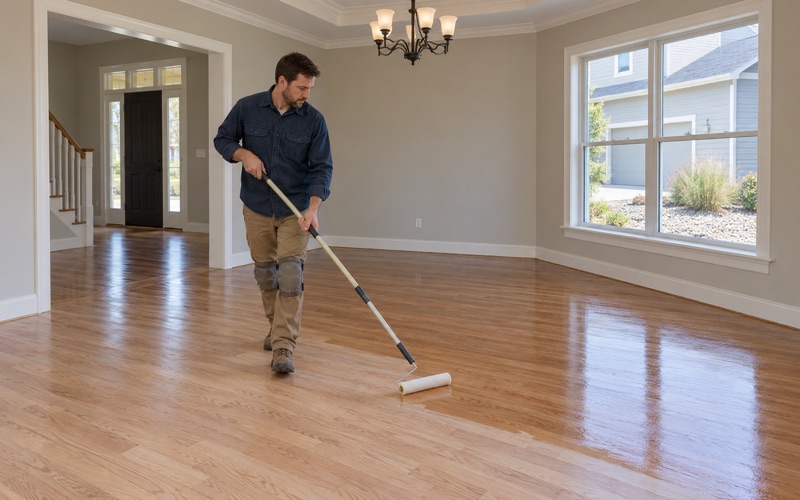
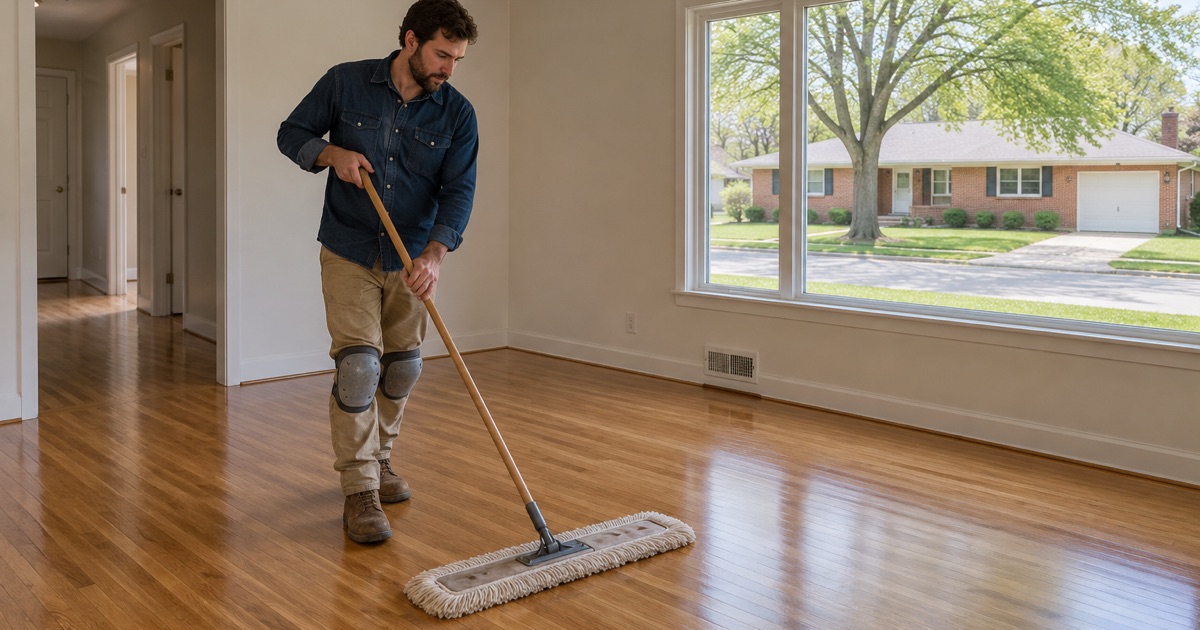
Not every floor needs to come out. A prefinished engineered floor with a worn finish but a sound surface may be a candidate for a screen and recoat once we test that a new coat will bond. A screen and recoat scuffs the top coat and adds fresh waterborne polyurethane without cutting into the wood, which suits a room where only the traffic lanes have dulled.
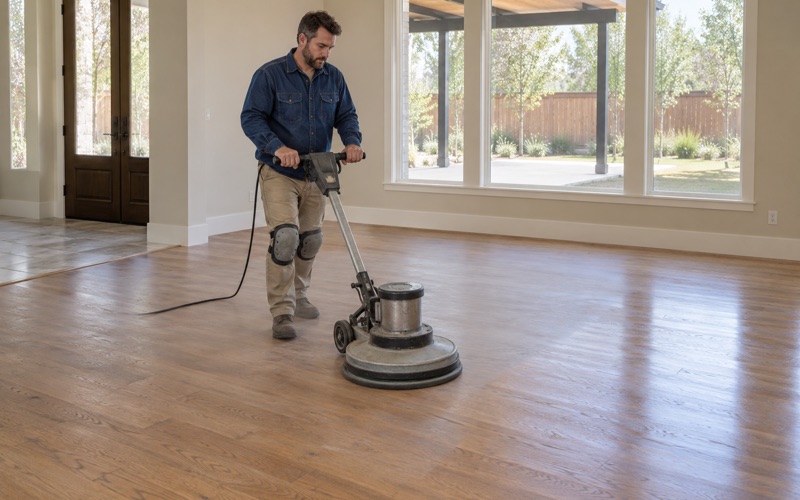
Full sanding depends on how much wood is left above the tongue, which we check before any drum sander touches the floor. Census figures put 33.1 percent of the city’s housing before 1980, so for a home built before 1978 we confirm the build year and look at painted surfaces before sanding starts.
Checking With the Park Before You Start
Talking to the Park Manager
Before we schedule a floor in a park home, we suggest a short conversation with the park manager. The questions are practical: where a crew can park, when noisy work is acceptable, where old carpet and cutoffs can be staged, and whether a dumpster or trailer can sit near the home for a day or two.
We ask because parks can differ in how they handle contractors on site. The ordinance sections we read deal with park and manager licenses, set-up, skirting and placement, not interior floors. Anything the park expects about work inside your home would come from its own policies, so the manager is the one to ask.
Reading Your Own Documents First
Any rule that touches your flooring lives in your own paperwork: a lot lease, a rental agreement, or the park’s written rules. We ask owners to pull those out before we quote, because a clause about noise hours or debris is far easier to plan around early than to discover with half the room torn up.
Renters in a park home have one more step: the home’s owner should give written go-ahead before any floor comes up. We are glad to talk the job through with both parties, and we put the scope in writing so everyone agrees to the same work. That includes the product, the transitions and where the debris goes.
Where Park Complaints Go
Sometimes a floor job surfaces a larger problem with the park itself, such as a dispute over maintenance or how a lease is enforced. Those complaints go to a state program instead. Federal Heights states plainly that the state Mobile Home Park Oversight Program is not administered by the City of Federal Heights.
The program sits within the Colorado Department of Local Affairs, Division of Housing. Residents can reach it at MHPOP@state.co.us or toll free at 1-833-924-1147, and the city hosts notices and complaint instructions in English and Spanish. We are not part of that process, but we can point you to it when a question goes beyond floors.
Moisture, Water and Winter Air
Acclimation Before a New Floor
Indoor air in a heated Front Range winter is far drier than the boards were when they left the mill, and a floor laid without accounting for that will move. We talk through the home’s humidity before installation, let the wood acclimate on site, and compare readings until the boards approach equilibrium moisture content with the room.
Winter also opens seasonal gaps between boards as the furnace runs. We read those gaps against the heating season before anyone suggests filling them, since a seam packed with filler in January can crush or push out once summer humidity closes it again. A whole-house humidifier is sometimes part of the answer, and we explain the tradeoffs honestly.
Water Damage From Supply Lines and Washers
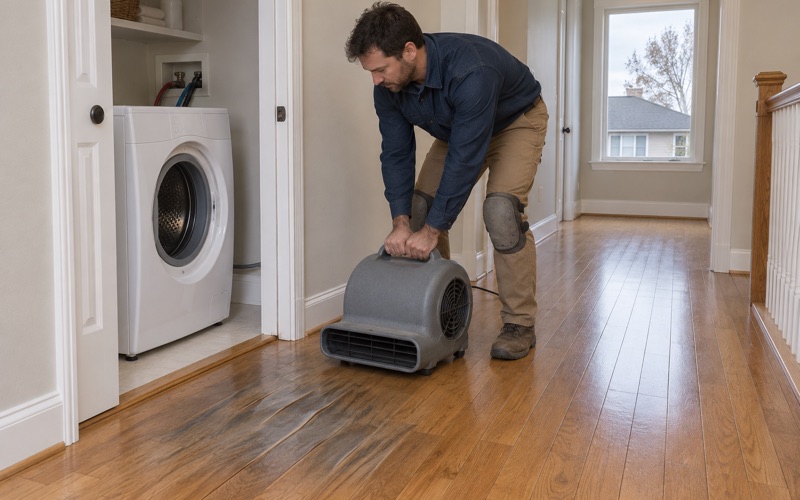
A leaking supply line under a sink or a washer that overflows can soak a floor quickly, and the damage often shows up as cupping or water stains well away from the source. We trace the water to where it started, dry the area, and measure moisture across the room before any board is replaced.
When an insurance claim is involved, we document the readings room by room so the adjuster sees the same picture we do. That record shows how far the water traveled, which boards can stay, and which need board replacement or a larger repair. Buckling and crowning are noted too, since they change the scope.
Squeaks, Popping Boards and Hollow Spots
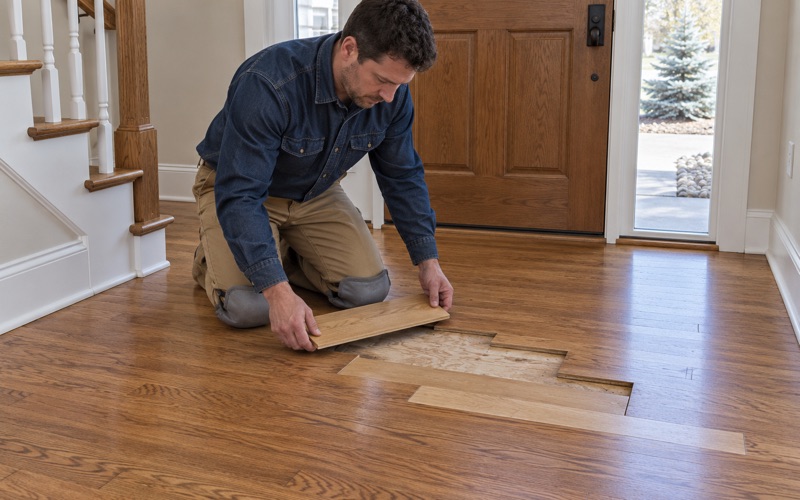
Squeaks and popping boards are common complaints in any home, and filling or masking them only buys time. We trace each noise to its cause, whether that is a loose fastener, a hollow spot under a floating floor, or movement where the floor meets a wall with too little expansion gap.
Cracks get the same treatment. Checking in the finish, veneer cracking on an engineered board and a split along a seam each point to something different, and the fix follows from which one it is. The goal is a floor that stays quiet and sound through the next winter, not one that only looks right the day we leave.
- 20+ Years on Wood Floors
- Moisture Readings Before Repairs
- Stain Samples on Your Own Floor